For many adults, a glasses prescription review every one to two years is a practical starting point, but symptoms, age, childhood vision changes and medical conditions can shorten that interval. You will learn when to book a routine review, when to seek an earlier assessment and how to tell whether a new prescription is ready to order.
Key takeaways
- Stable adults can review spectacle power annually or when symptoms appear.
- Children and teenagers need more frequent checks because their eyes are still developing.
- Blurred vision, headaches, squinting or eye strain warrant an earlier test.
- Compare sphere, cylinder, axis and pupillary distance before ordering new lenses.
A practical recheck schedule for adults by age
How often to check glasses power in Mumbai has no separate Mumbai-specific interval. For an adult with stable spectacle power, no new symptoms and no known eye disease, use age and risk as the guide. A glasses wearer can also have the prescription reviewed at an annual eye visit if their eye-care professional recommends it.
| Age | Routine comprehensive eye examination |
|---|---|
| 20–39 | Every 5–10 years; review sooner if you wear glasses and notice change |
| 40–54 | Every 2–4 years, including assessment of near vision and reading comfort |
| 55–64 | Every 1–3 years |
| 65 and older | Every 1–2 years |
Do not wait for the calendar if blur, headaches, eyestrain, increased squinting, double vision, glare, or difficulty driving at night develops. Arrange an earlier review. High myopia, diabetes, previous retinal disease, or a strong family history of eye disease calls for an individual schedule; diabetes also requires retinal checks, not repeated refraction alone.
Flashes, a sudden shower of new floaters, a dark curtain or shadow, or sudden vision loss require prompt ophthalmic assessment rather than a routine glasses-power test. These symptoms can signal retinal detachment or another urgent eye problem.
Why children, teenagers and people over 40 need different timing
A child’s prescription can change within months because the eye is still growing. Children with myopia or a changing prescription often need a review every 6–12 months; school screening does not replace a full eye examination.
Teenagers also need closer monitoring than adults with stable vision. Growth-related myopia can progress through the school years, so arrange a review about every 6–12 months when the prescription is changing, or sooner if classroom blur, squinting or headaches appear.
Use this checklist when deciding when to recheck spectacle power:
- Under 18: book the interval recommended by the examining clinician, commonly 6–12 months for changing prescriptions.
- Around 40–45: ask for near-vision assessment, even if distance vision remains clear.
- Over 40: review near addition and reading comfort at routine eye visits; presbyopia progresses gradually and often requires stronger reading support over time.
- Any age: book sooner for new blur, eyestrain, headaches, double vision, increased squinting, night-driving difficulty or glare.
Presbyopia is not simply “old glasses power.” It is the reduced ability to focus close objects, so a distance prescription can remain suitable while your reading addition changes. A proper review checks both.
Symptoms that mean you should test sooner
Blurred vision, new headaches, eyestrain, more squinting, difficult reading, glare or worsening night driving all justify an earlier review rather than waiting for the calendar. The question of when to recheck spectacle power depends on symptoms and risk. Diabetes, high myopia and contact-lens wear also require more than a glasses prescription check.
- Book a prompt power review if one eye seems different, you need frequent prescription changes, or near work has become uncomfortable.
- If you have diabetes, arrange retinal follow-up as advised; changing blood glucose can temporarily alter the measured power, while diabetic retinopathy requires separate monitoring.
- If you wear contact lenses, request corneal health and lens-fit assessment as well as refraction. A spectacle prescription cannot be substituted for a contact-lens prescription.
| Symptom | What it may indicate | Action |
|---|---|---|
| Flashes, sudden new floaters, a dark curtain or shadow | Retinal tear or detachment | Seek urgent ophthalmic assessment today; do not wait for a routine test |
| Sudden vision loss or sudden double vision | An urgent eye or neurological problem | Attend emergency ophthalmic care immediately |
| Gradual blur, headaches, eyestrain or increased squinting | Changed refractive error or another eye issue | Arrange an earlier comprehensive examination |
| High myopia with new flashes or floaters | Increased retinal-complication risk | Seek prompt assessment and follow the recommended dilated-exam schedule |
What a proper glasses power test actually measures
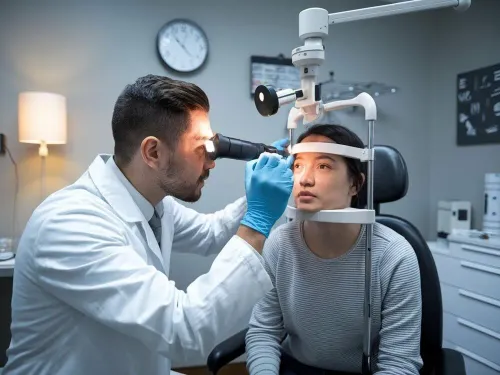
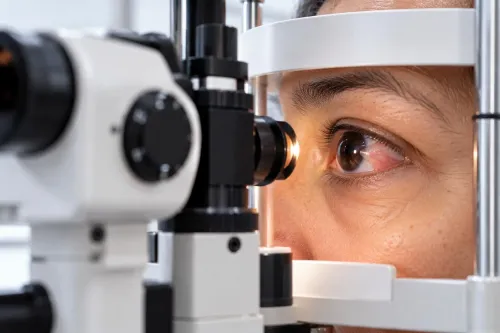
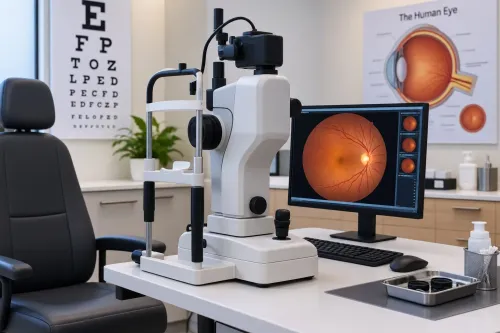
An autorefractor gives an estimate, not automatically the prescription you should wear. A proper glasses power test in Mumbai checks how clearly you see, refines the lens power for comfort, and looks for eye conditions that blurred vision alone cannot explain.
- The clinician records symptoms, previous glasses, medical conditions and medicines. Diabetes matters because substantial blood-glucose changes can temporarily alter the reading.
- Distance and near visual acuity are measured, usually one eye at a time and then together, using an eye chart.
- Objective refraction uses an autorefractor or retinoscope to estimate sphere, cylinder and axis. The machine measures optics; it cannot judge which result feels clearest.
- Subjective refraction refines those numbers. You compare lens choices, and the examiner checks clarity, balance between the eyes and near addition when required.
- The examination assesses ocular health, including the cornea, lens, optic nerve and retina. A power change can reflect more than ordinary refractive error.
The useful record from an eye power measurement in Mumbai is the complete prescription: sphere, cylinder, axis and near addition. Pupillary distance and optical-centre placement affect fitting and comfort, but they are not evidence that your eye power has changed.
How to compare an old and new prescription before ordering lenses
Before ordering lenses, compare the complete prescription, not a single “power” number. A glasses power test in Mumbai should record each eye separately and include these fields:
| Prescription item | What to compare | What a change means |
|---|---|---|
| Sphere | Plus or minus strength | Changes distance focus; a larger change deserves confirmation |
| Cylinder | Astigmatism strength | Changes correction for uneven curvature |
| Axis | Direction from 1 to 180 degrees | A small rotation can feel significant when cylinder is high |
| Near addition | Extra plus power for reading or progressive lenses | Reflects near-focus needs, not distance power |
| PD and optical centres | Pupillary distance and lens-centre placement | Incorrect fitting can cause blur or headache without changed eye power |
An autorefractor result is only an estimate. Compare the final subjective prescription from distance and near testing, and ask whether the readings were taken with controlled viewing distance and relaxed accommodation. Dry, tired eyes or inconsistent responses justify repeating the test rather than automatically ordering stronger lenses.
Ask for a trial frame when the prescription changes substantially, cylinder or axis changes, the two eyes differ noticeably, or you are switching to progressive lenses. Wear it for distance, reading and ordinary head movement; discomfort, persistent blur, imbalance or headache means the prescription or fitting needs review before glazing.
When a power recheck needs a full eye-health assessment
Blur that persists after a careful refraction needs an eye-health assessment, not another prescription. Dry eye, cataract, corneal disease, retinal disease, medication effects and poorly controlled diabetes can reduce vision while the measured power remains unchanged. A comprehensive examination checks visual acuity, refraction and ocular structures, rather than relying on an autorefractor or optical-counter reading.
Book this assessment promptly if you have:
- Diabetes, especially with changing or fluctuating vision.
- High myopia, which raises retinal-complication risk and may warrant dilated retinal examinations at shorter intervals.
- Contact lenses, because a spectacle prescription cannot substitute for a lens-fit, corneal and eye-health review.
- Unexplained vision loss, persistent one-eye blur, double vision or a marked difference between the eyes.
Flashes, a sudden shower of new floaters, a dark curtain or shadow, or sudden vision loss require urgent ophthalmic assessment, not routine eye power measurement in Mumbai. Remove contact lenses and seek care for pain, redness, light sensitivity or discharge.
Dr Nusrat Bukhari's Eye Clinic can help distinguish a usable prescription change from a condition requiring medical treatment. Ask when to recheck spectacle power based on the finding, not just the calendar.
Frequently asked questions
How often should adults recheck their glasses power in Mumbai?
Adults with stable power, no new symptoms and no known eye disease can use age and risk as guides. An annual eye visit is a practical opportunity to review the prescription when recommended by an eye-care professional.
Why do children and teenagers need glasses power checks more often?
Children and teenagers are still growing, so their spectacle power can change faster. Regular reviews help detect changes before they affect classroom vision, reading or daily activities.
What symptoms mean you should recheck spectacle power sooner?
Arrange an earlier test for new or worsening blur, headaches, squinting, eye strain, double vision, difficulty reading or trouble seeing at night.
What does a glasses power test measure?
A proper test measures the lens power needed for each eye, including sphere, cylinder and axis when astigmatism is present. It may also record pupillary distance, but a full eye-health assessment is needed to check for disease.
When does a power recheck need a full eye-health assessment?
Request a full assessment when you have eye pain, flashes, new floaters, a curtain-like shadow, sudden vision loss, unequal vision, diabetes, known eye disease or a significant prescription change.
Keywords